Showing posts with label Beer Recipes. Show all posts

Saturday, August 20, 2011

Fruit Beer (Kiwi-Strawberry)

I'm not one to hide things, so I'll just say it: for the Queen of Beer competition, I'm going to send in a kiwi-strawberry wheat beer (extract).

Courtesy of ifood.tv
I'm still not confident enough to brew an all-grain but I think this will be my last extract. I have equipment I can borrow from my buddy, Tom (who just won First Place in the Krolsch division at the L.A. County Fair homebrew competition, woot! woot!) but, to be honest, borrowing stuff sucks. In the words of Veruca Salt, "I want [brewing equipment] NOW!" Fine, I'll wait.


Anyhoo, my other brewing buddy, Teela Smith (who one Second Place in the 2009 Queen of Beer Fruit group with her Sassy Strawberry, woot! woot!), is brewing two spectacular beers as well, but I'm not giving away her secret here.

Courtesy Strawberriesweb.com
I decided to go with fruit because I've never attempted it before. The only things I'm worried about are dryness and a tart taste (from the kiwi). Will the fruit dry out the beer? Will the pound of kiwis I'm using in the secondary be too much? That's the fun part of brewing - you just don't know. You can make a guesstimate as to the flavor and body, but you just really never know unless you've perfected it which, of course, I haven't.

Fortunately, Tom, at Stein Fillers in Lakewood, Calif., helped me out a bit and handed me a great wheat kit along with some invaluable help. Thanks, Tom!


Here's the recipe:

Malt: 6 lbs. wheat malt extract
Grain: 1 lb. Crystal malt
Hops: .5 oz. Centennial
Yeast: Safale US-05 ale yeast (dry)
Fruit: 3 lbs. Fresh strawberries, 1 lb. fresh kiwis

I'm going to experiment a bit with the fruit and add the strawberries in the primary after four days, letting it sit for three days; then add the kiwis in the secondary for four days before bottling. We'll see what happens!

I'll go into fruit beers a little later, but for now, I'm off to brew!

Sunday, July 24, 2011

The Perfect Day to Brew (Saison and Belgian Tripel)

Could today have been anymore perfect? In my world, no, I don't believe it could have been. I left good ole armpit Bakersfield at 7 a.m. and pulled into Long Beach about 8:45...already perfect. This is normally a two- to three-hour drive. Did I mention there's a nice marine layer and it's a cool 65 degrees outside? Oooooh yah ... perfect.

Our brewing session was to start at 9 a.m. and who had his backyard all set and ready to go? That's right, Josh. Another perfect moment. Here was the setup:


As the sun peeped above the rooftops, Josh and Tom started that old ritual of sanitizing and boiling water. They're brewing a saison and a tripel for an upcoming extract competition. Here are the recipes:

TRIPEL
Grain:
Cara-Vienne
Aromatic

Fermentables:
Muntons extra-light DME
Clear Belgian Candi Sugar

Hops:
Styrian Goldings
German Hallertau Hersbrucker
Tettnanger
Saaz

Adjuncts:
Sweet Orange Peel

Yeast:
Belgian Abby Ale


SAISON
Grains:
Wheat LME
Munich malt
Rye malt

Fermentables:
Candy Sugar (clear)

Adjuncts:
Coriander

Yeast:
Belgian Saison Blend


Let's go into these beers a bit.

SAISON

Saisons are also known as "farmhouse saisons." Why? Because they were originally brewed in farmhouses in Wallonia, Belgium (French-speaking Belgium) during harvest season. Saison means "season" in French, p.s. It's generally a low-ABV pale ale.

Today, saisons are brewed everywhere and usually have a higher ABV than their ancestors, anywhere from 5% to 8%.

So why is it called "season?" Because the original brewers had to brew during fall or winter in order to keep the ale from spoiling when stored. The threat of water-borne illness to farm hands was avoided by giving them this low-alcohol beer. They used to be REALLY hopped in order to act as a preservative, and hops also has antiseptic properties. Hence the reason they were often dry-hopped and still are.

According to the "BJCP Style Guidelines," saisons are to be "high in fruitniness with low to moderate hop aroma and moderate to no herbs, spice and alcohol aroma." On color: "Often a distinctive pale orange but may be golden or amber." On flavor: "Combination of fruity and spicy flavors supported by a soft malt character, a low to moderate alcohol presence and tart sourness ...

"... Hop flavor is low to moderate, and is generally spicy or earthy in character."

Saison = Delicious


BELGIAN TRIPEL
Basically, a tripel is a strong pale ale. Remember my definition of Trappist ales? Well, the tripel is known to have been brewed by the Trappist brewery, Westmalle, in 1956 (For more info, go here.)

The name refers to the strength of the beer or the original gravity. ABV for these brews are 3 percent, 6 percent and 9 percent. In other words, according to the great Michael Jackson, beer king, the term tripel is "usually applied to the strongest beer of the house." I concur.

According to the "BJCP Style Guide," a Belgian tripel's aroma is "complex with moderate to significant spiciness, moderate fruity esters and low alcohol and hop aromas." On appearance: "Deep yellow to deep gold in color. Good clarity." On flavor: "Marriage of spicy, fruity and alcohol flavors supported by a soft malt character ... Esters are reminiscent of citrus fruit, such as orange or sometimes lemon."

Belgian tripel = Amazing

Check out our wonderful day in pictures!


The tripel, doing its thang...

...and the saison, workin' it.

If you know Roxy, you know why she's licking her chops!

Something you don't see in Long Beach everyday - clean, sanitary water.

Yours truly - fools in back.


This clarifier doesn't look very clarifying, but I promise, it is!

Birds-eye view of the freshly poured tripel.
Nah, it's cool guys, I'll just use my mouth.


A frighteningly low 1.094

Tom, doin' it the right way. :)

Check out that form! No, it's not cottatge cheese.

The saison's original gravity was 1.084 ... oooooh yah!


Sunday, June 5, 2011

Belgian Trappist Ale


Today I brewed a Belgian Trappist Ale with my brewing partner/teacher, Nosh, thanks to a Stein Fillers kit (Lakewood, CA). I’ll start with the recipe:

Belgian Trappist Beer Recipe (Inspired by Chimay Red)
MALT: 8 lbs. Pale Malt Extract
              1.5 lbs. Candi Sugar

GRAIN: Wheat Malt (.5 lbs)
               Belgian Aromatic (.5 lbs)
               Belgian CaraMunich (.25 lbs)
               Chocolate Malt (.1 lb)

HOPS: Tettnanger (2 oz, boil)
             Styrian Golding (.5 oz, finish)

YEAST: White Labs Trappist Ale Yeast

Damn, I make a good beer!
Courtesy beerandheavymetal.com
Those crazy Catholics! Ironic, isn’t it? That only a true trappist brews can come from trappist breweries, which are run and brewed, by trappist monks. Yes, those quiet, self-sufficient, holier-than-thou monks who live in solitude and devote their entire lives to “God” as they know him or her. The ironic part is that, although the Catholic church  celebrates many saints related to alcohol, many offshoots of the church see alcohol as the devil’s blood, inherent evil that contributes to poverty, unemployment and crime. And, honestly, it kind of does, doesn’t it? I mean, who hasn’t been freaked out a little when a poverty-stricken homeless person smelling of cheap gin drunkenly stumbles over to you asking for a bite of that slice of that pizza you’re walking home with? (Yes, that happened … hey, I live in Long Beach, what do you expect?)

Despite those profound religious indoctrinations, I think that after reading this you might have much more appreciation for trappist beers. They are brewed by trappist monks … and only trappist monks … well, if you want a “real” trappist that’s been labeled an Authentic Trappist Product.
            Ever excitedly popped open a Chimay or La Trappe? If so, it was brewed under strict conditions, including:
1.      Must have been brewed in a trappist abbey under the control of trappist monks
2.      Anything commercial having to do with the beer must depend on the monastic community
3.      The money earned from sales of these beers must not be for financial profit; the money must be directed toward helping a community

Here are the eight trappist breweries:

  1. Bières de Chimay (Belgium)
  2. Brasserie d'Orval (Belgium)
  3. Brasserie de Rochefort (Belgium)
  4. Brouwerij der Trappisten van Westmalle (Belgium)
  5. Brouwerij Westvleteren (Belgium) (This is number-one on my 20 Beers in My Future list)
  6. Brouwerij der Sint-Benedictusabdij de Achelse Kluis (Belgium)
  7. Brouwerij de Koningshoeven (Netherlands)
  8. Mont des Cats (France)
Don’t be fooled by those beers called “abbey ales.” True, they probably practice perfect Belgian beer-brewing practices, but they are not true trappists.

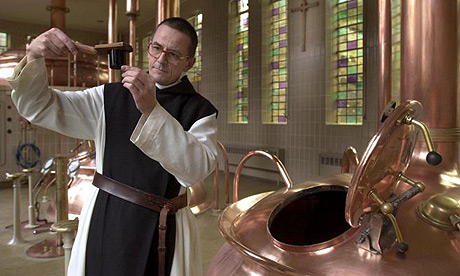
Trappist monk testing his brew. Courtesy London Slow Food

What was the first Belgian trappist beer brewed? When was it first brewed? What the hell is a trappist? Where am I? What’s my name? Hold on … take a deep breath. There is much to learn, and I can’t possibly get into every detail about this fine drink, but I can at least get the gist of it down.

Let’s start with who the trappist monks are. What it boils down to is they are people of a Catholic religious order of monks and nuns. They live what’s called a Cistercian life, which means they are self-sufficient and base their days around manual labor. They first started in France, moving on over to the Netherlands and Belgium. Well, they probably didn’t “move” per se, they just happened to be chopped up among political dividing lines way back when. Waaaaaaay back when. Like, the year 1,000.

Why did trappists brew beer? That’s much simpler than explaining what a trappist monk is — to feed their community. Not only feed their community, but feed it with a drink that wouldn’t kill them. Water was obviously disgusting back then, and they knew that boiling the water was possibly a lifesaver. On a side note, some say monks actually discovered using hops in beer, too … in the 15th century.

Now that I know there are certain trappist beers you can only get at certain monasteries, I have a mission! Brouwerij Westvleteren sells very limited amounts only at the monastery, and only after having made a reservation ahead of time. Now that’s an exclusive beer! I’m surprised you don’t have to also fly a monastery-built jet and land in a monastery-run airport to get it! You also have to agree to not sell it to anyone; you can only drink it yourself. I might share with you, but not if it’s against the rules.

The first trappist beer? Who really knows? It’s said the monasteries were brewing before the Middle Ages, but the first known proof of an official trappist brewery is said to be 1685, La Trappe.

Do yourself a favor and either follow the Belgian trappist recipe above and delight your senses in six weeks or find yourself a true trappist beer with the logo that states it is an Authentic Trappist Product and welcome yourself to the world of some of the finest beers ever created. Some have said that Red Chimay leaves a “silky sensation” in your mouth. Sounds sexy, doesn’t it? Well, as sexy as a monk-made beer can be.