Sunday, June 5, 2011

Belgian Trappist Ale


Today I brewed a Belgian Trappist Ale with my brewing partner/teacher, Nosh, thanks to a Stein Fillers kit (Lakewood, CA). I’ll start with the recipe:

Belgian Trappist Beer Recipe (Inspired by Chimay Red)
MALT: 8 lbs. Pale Malt Extract
              1.5 lbs. Candi Sugar

GRAIN: Wheat Malt (.5 lbs)
               Belgian Aromatic (.5 lbs)
               Belgian CaraMunich (.25 lbs)
               Chocolate Malt (.1 lb)

HOPS: Tettnanger (2 oz, boil)
             Styrian Golding (.5 oz, finish)

YEAST: White Labs Trappist Ale Yeast

Damn, I make a good beer!
Courtesy beerandheavymetal.com
Those crazy Catholics! Ironic, isn’t it? That only a true trappist brews can come from trappist breweries, which are run and brewed, by trappist monks. Yes, those quiet, self-sufficient, holier-than-thou monks who live in solitude and devote their entire lives to “God” as they know him or her. The ironic part is that, although the Catholic church  celebrates many saints related to alcohol, many offshoots of the church see alcohol as the devil’s blood, inherent evil that contributes to poverty, unemployment and crime. And, honestly, it kind of does, doesn’t it? I mean, who hasn’t been freaked out a little when a poverty-stricken homeless person smelling of cheap gin drunkenly stumbles over to you asking for a bite of that slice of that pizza you’re walking home with? (Yes, that happened … hey, I live in Long Beach, what do you expect?)

Despite those profound religious indoctrinations, I think that after reading this you might have much more appreciation for trappist beers. They are brewed by trappist monks … and only trappist monks … well, if you want a “real” trappist that’s been labeled an Authentic Trappist Product.
            Ever excitedly popped open a Chimay or La Trappe? If so, it was brewed under strict conditions, including:
1.      Must have been brewed in a trappist abbey under the control of trappist monks
2.      Anything commercial having to do with the beer must depend on the monastic community
3.      The money earned from sales of these beers must not be for financial profit; the money must be directed toward helping a community

Here are the eight trappist breweries:

  1. Bières de Chimay (Belgium)
  2. Brasserie d'Orval (Belgium)
  3. Brasserie de Rochefort (Belgium)
  4. Brouwerij der Trappisten van Westmalle (Belgium)
  5. Brouwerij Westvleteren (Belgium) (This is number-one on my 20 Beers in My Future list)
  6. Brouwerij der Sint-Benedictusabdij de Achelse Kluis (Belgium)
  7. Brouwerij de Koningshoeven (Netherlands)
  8. Mont des Cats (France)
Don’t be fooled by those beers called “abbey ales.” True, they probably practice perfect Belgian beer-brewing practices, but they are not true trappists.
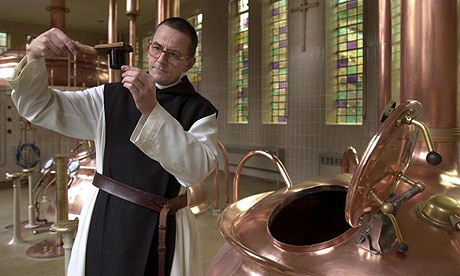
Trappist monk testing his brew. Courtesy London Slow Food

What was the first Belgian trappist beer brewed? When was it first brewed? What the hell is a trappist? Where am I? What’s my name? Hold on … take a deep breath. There is much to learn, and I can’t possibly get into every detail about this fine drink, but I can at least get the gist of it down.

Let’s start with who the trappist monks are. What it boils down to is they are people of a Catholic religious order of monks and nuns. They live what’s called a Cistercian life, which means they are self-sufficient and base their days around manual labor. They first started in France, moving on over to the Netherlands and Belgium. Well, they probably didn’t “move” per se, they just happened to be chopped up among political dividing lines way back when. Waaaaaaay back when. Like, the year 1,000.

Why did trappists brew beer? That’s much simpler than explaining what a trappist monk is — to feed their community. Not only feed their community, but feed it with a drink that wouldn’t kill them. Water was obviously disgusting back then, and they knew that boiling the water was possibly a lifesaver. On a side note, some say monks actually discovered using hops in beer, too … in the 15th century.

Now that I know there are certain trappist beers you can only get at certain monasteries, I have a mission! Brouwerij Westvleteren sells very limited amounts only at the monastery, and only after having made a reservation ahead of time. Now that’s an exclusive beer! I’m surprised you don’t have to also fly a monastery-built jet and land in a monastery-run airport to get it! You also have to agree to not sell it to anyone; you can only drink it yourself. I might share with you, but not if it’s against the rules.

The first trappist beer? Who really knows? It’s said the monasteries were brewing before the Middle Ages, but the first known proof of an official trappist brewery is said to be 1685, La Trappe.

Do yourself a favor and either follow the Belgian trappist recipe above and delight your senses in six weeks or find yourself a true trappist beer with the logo that states it is an Authentic Trappist Product and welcome yourself to the world of some of the finest beers ever created. Some have said that Red Chimay leaves a “silky sensation” in your mouth. Sounds sexy, doesn’t it? Well, as sexy as a monk-made beer can be.


Friday, June 3, 2011

Budweiser to Men: Don’t Shave, Save Water

From Urban Farm Online:


As part of its "Grow One. Save a Million." program, Budweiser wants men to do their part for World Environment Day.


June 3, 2011

 
Photo: Courtesy iStockphoto/Thinkstock
 Budweiser is encouraging men to not shave in order to
save water.

This weekend, as the international community gears up for World Environment Day (June 5, 2011), Budweiser is asking adult men across the U.S. to help save 1 million gallons of water by not shaving.

As part of Budweiser’s ongoing commitment to water conservation, the “Grow One. Save a Million.” program encourages consumers to get involved by skipping a shave. The average shave uses 3 to 10 gallons of water.

Consumers 21 years of age and older can visit Budweiser’s Facebook page to make a pledge and share the water-conservation program with Facebook friends. Participants can commit to a range of no-shaving options, from a few days to multiple weeks. The page also features a daily tracker of the gallons of water saved to date.

“Water is a key ingredient in brewing Budweiser and all our beers, which is why water conservation is a priority both inside and outside our breweries,” says Kathy Casso, vice president of Corporate Social Responsibility at Anheuser-Busch. “In the past three years alone, our 12 U.S. breweries have reduced water use by 34 percent. Additionally, our employees and their families take action by volunteering to participate in local river-cleanup projects in communities across the country.”

In 2010, more than 1,200 employees from Budweiser brewer Anheuser-Busch skipped shaving for one week prior to World Environment Day, helping to save about 42,000 gallons of water. This year, Budweiser is expanding the water-conservation effort by inviting suppliers, partners, wholesalers, retailers and consumers to join the effort.

“Every gallon of water that we conserve makes a difference to our communities. So when thousands of people get together for one common cause, great things can happen,” says Chad Pregracke, founder of Living Lands & Waters and the face of the program on Budweiser’s Facebook page. “By pledging to skip shaving and ‘grow one,’ guys can literally wear their commitment to conserving our most valuable natural resource.”

In 1998, Pregracke founded Living Lands & Waters, a non-profit organization based in East Moline, Ill., dedicated to cleaning up and preserving U.S. rivers. For 20 years, River Network has provided organizational, technical and networking assistance to people working for watershed protection at the local, state and regional levels. Today, the organization has grown to include 10 full-time employees. Since the organization’s inception, more than 60,000 volunteers have helped remove more than 6 million pounds of debris from rivers. For his efforts, Pregracke has received numerous national awards.

As part of its annual recognition of World Environment Day, Anheuser-Busch and its Budweiser brand will again donate $150,000 to River Network to help support the organization’s watershed-conservation projects in each of the company’s 12 U.S. brewery cities. These projects will include stream and river cleanups, education programs, tree plantings and various activities that support the environment and provide employees and local wholesalers the opportunity to volunteer in their communities.

World Environment Day is a day set aside by the United Nations to create awareness of the environment and encourage participation in sustainability programs.

Thursday, June 2, 2011

St. Louis Post-Dispatch Releases 'Brew in the Lou'

St. Louis Post-Dispatch Releases Brew in the Lou

ST. LOUIS, May 27, 2011 /PRNewswire/ -- The St. Louis Post-Dispatch has released its new book, Brew in the Lou: St. Louis' Beer Culture - Past, Present and Future. In the newspaper's new 160-page, full-color book, Post-Dispatch features editor, reporter and beer columnist Evan Benn explores the beginning of beer in the caves beneath the Lemp and Anheuser-Busch breweries to the craft beer explosion happening today.
Additionally, readers can find out what's in store from a new generation of locally owned, small-production breweries and brewpubs, build up a thirst while looking at great photos, and get suggestions for meal and beer pairings.

Brew in the Lou: St. Louis' Beer Culture - Past, Present and Future retails for $19.95 (tradecloth) and is currently available at the Post-Dispatch online store, www.thepost-dispatchstore.com and in local bookstores.

Wednesday, June 1, 2011

Think You Don't Have Time to Brew?

Think again! Come on, you know you've been letting that brewing kit your wife bought you for your 35th birthday sit in a dark, lonely, spider-web-infested corner of your garage to collect dust. What is it that's allowing you to leave it like that ... all ... lonely? You have the beer-making book, you're an armchair beer enthusiast, so stop letting your tired old bones hold you back!

Work schmork. Since when does anyone leave work at 5, sit in traffic for an hour and then get home and jump right into their hobby? Unless your hobby is sitting on the couch with your tie slightly askew, smelling like the freeway, then you're one of millions who just want to relax after work. But that still doesn't mean you don't have time to learn how to make your own beer. You still have those precious 2,880 minutes of free time during the weekend to both enjoy a craft beer AND brew your own!

Ok, so you have kids. And? Kids are great slaves ... I mean, helpers. Need something sanitized? Your kid'll do it. Send him or her outside with your fermenting bucket and a dollop of sanitizer, turn on the hose and voila! Instant sanitizing slave. And really, what more does your kid want than to just spend time with you? That could very well mean sitting on a bar stool in the kitchen as you babble on about original gravity and barley for three hours (which is about the maximum time you'll need with an extract recipe). Your little one will love hanging out with you! You're showing him or her science. Yep, that's right -- science. You'll be doing your child some serious good by having them join you in learning how to brew beer. You wouldn't dare deny your child science, would you?


Now you have no excuse to not brew beer at home. Do you and your family a favor, and just brew some beer!